Why Your Go-To Easy Dinner Tastes Different Depending on Which Store You Shop At
Quick Answer: Store-brand and produce differences — ripeness, salt content in canned goods, oil freshness, and even chicken brine additives — can shift the same recipe’s flavor noticeably from store to store. Checking labels for sodium and additives, and buying produce closer to peak ripeness, closes most of the gap.
You make the exact same 20-minute pasta every week, and some weeks it’s great and some weeks it’s just fine, even though you followed the same steps. The recipe didn’t change — the ingredients quietly did, based on which store’s cart you pushed that week.

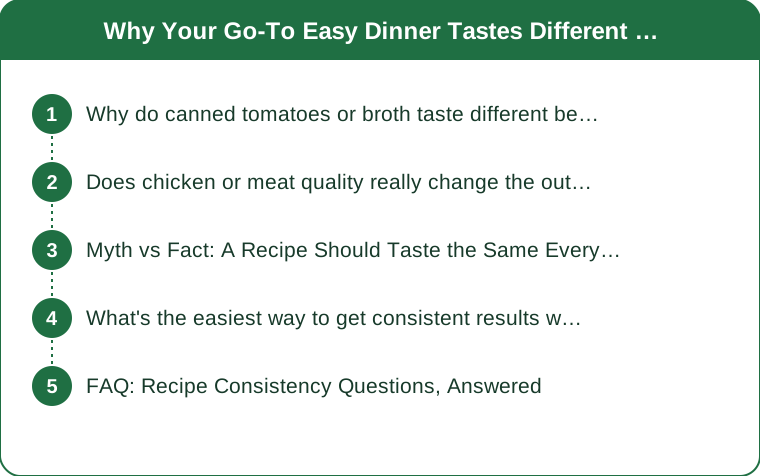
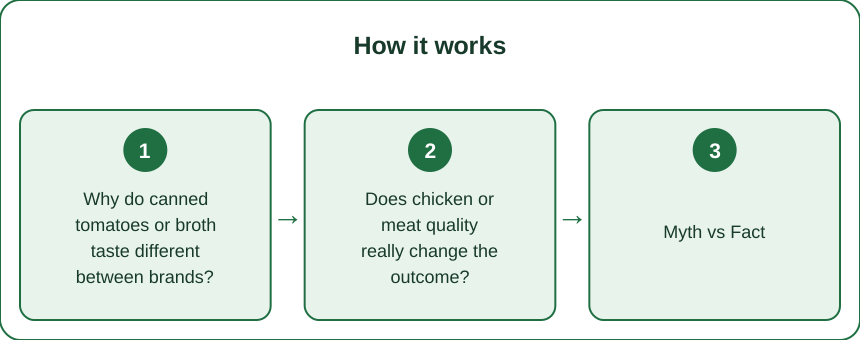
Why do canned tomatoes or broth taste different between brands?
Sodium content varies significantly between store brands and national brands — some canned tomatoes and broths carry nearly double the sodium of others, which changes the whole dish’s salt balance even when you measure everything else identically.
Check the nutrition label’s sodium-per-serving number specifically; if you switch store brands, adjust your added salt down or up to compensate rather than assuming the recipe itself needs more seasoning.
Does chicken or meat quality really change the outcome?
Yes — many store-brand chicken breasts are injected with a saline or broth solution (check the label for “contains up to X% solution”), which affects both sodium and how much liquid releases during cooking. A solution-injected chicken breast can make a stir-fry noticeably wetter and saltier than an unenhanced one, even with identical seasoning.
If a dinner suddenly seems soggier or saltier than usual, checking whether your usual chicken brand changed its solution percentage is worth a look before blaming the recipe.

Myth vs Fact: A Recipe Should Taste the Same Everywhere
Myth: If you follow the recipe exactly, the result should be identical regardless of ingredient source. Fact: Recipes assume a baseline ingredient quality that isn’t standardized across brands — sodium, ripeness, and oil freshness all vary enough to shift outcomes meaningfully.
Myth: Store brand and name brand are functionally the same for cooking. Fact: For some categories (canned tomatoes, broth, oil) they often are; for others (enhanced meats, pre-shredded cheese with anti-caking agents) they can behave quite differently in a dish.
What’s the easiest way to get consistent results week to week?
Stick with one brand per key ingredient once you find a version that works — this is more reliable than sticking with one store, since even the same store’s shelf can rotate which brand is on sale and in stock.
For produce specifically, buy tomatoes, herbs, and other flavor-driving items closer to peak ripeness rather than whatever’s cheapest that week; a bland winter tomato will flatten a sauce no matter how well the rest of the recipe is executed.
FAQ: Recipe Consistency Questions, Answered
Does olive oil quality really make a noticeable difference?
Yes, especially in simple dishes where oil is a primary flavor carrier — a fresher, higher-quality oil (check the harvest date, not just “extra virgin” on the label) makes a bigger difference in a simple pasta than in a heavily-spiced dish.
Should I adjust seasoning every time I switch brands?
It’s worth a quick taste-and-adjust step the first time you try a new brand of a key ingredient, then note what worked so you’re not re-guessing every week.
Is frozen produce more or less consistent than fresh?
Often more consistent, since frozen produce is typically processed at peak ripeness — for herbs and vegetables where ripeness varies a lot at the store, frozen can actually give more predictable results.
TL;DR:
- Sodium content in canned goods and broth varies enough between brands to shift a whole dish’s balance
- Enhanced/solution-injected meat changes both salt and moisture in the final result
- Stick with one trusted brand per key ingredient for consistent week-to-week results
- Frozen produce can be more consistent than fresh when ripeness varies a lot at your store
Keep Reading
This article is for general informational purposes only and is not medical advice. Always consult a qualified health professional for guidance specific to you.