The Fifteen Minute Dinner That Actually Takes Fifteen Minutes
Quick Answer: A genuine fifteen-minute dinner uses one heat source, needs no preheating, involves no more than three cutting tasks, and cooks the longest element first while everything else is prepared alongside it. Recipes fail their timing when they hide preheating, assume prepped ingredients, or need two pans running at different speeds.
The fifteen-minute claim is usually true for the person who wrote it and false for everyone else, and the reasons are structural rather than about speed.
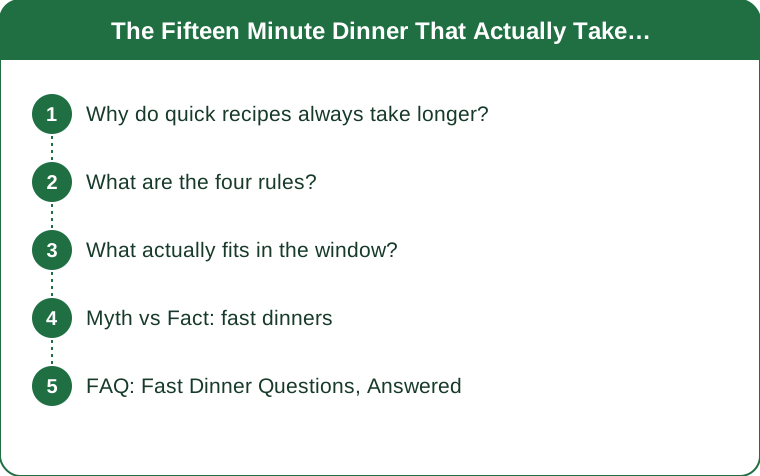
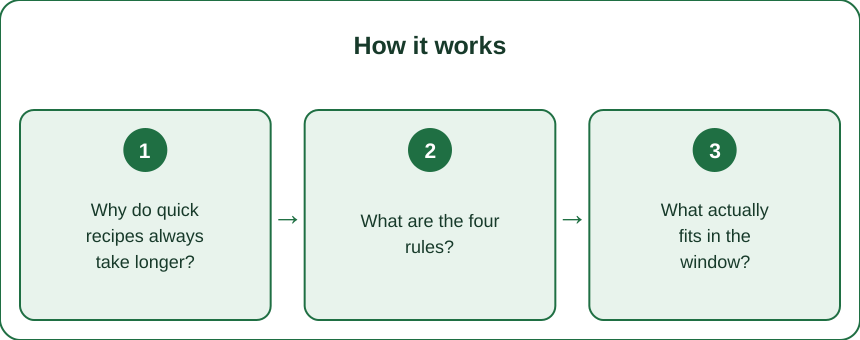
Why do quick recipes always take longer?
Four specific omissions, and each one adds five to ten minutes.
Preheating is never counted. An oven at 400°F takes 10-15 minutes to get there. A recipe that says 20 minutes and starts with ‘preheat the oven’ is a 35-minute recipe. Any genuinely fast dinner uses the stovetop, because a pan is hot in ninety seconds.
Prep is assumed done. ‘One diced onion, two cloves garlic minced, a chopped pepper’ is presented as an ingredient list and is actually six minutes of knife work. Recipes written by people who cook professionally assume mise en place because that is how professional kitchens work.
Multiple pans mean multiple attention streams. Two pans at different stages requires monitoring, and monitoring is where time silently goes. One pan is faster than two even when the two are theoretically parallel.
Cleanup is never counted at all. A recipe using a food processor, two pans, and a colander is not fifteen minutes of your evening. It is fifteen minutes of cooking and twelve of washing up.
A real fifteen-minute dinner has to be designed against all four.
What are the four rules?
These are the structural constraints. Anything meeting all four genuinely fits.
Rule 1: One heat source, no preheating. One pan or one pot on the stovetop. No oven, no grill. If something needs to be hot before food goes in, the clock has already started against you.
Rule 2: Maximum three cutting tasks. Count them honestly. An onion, a protein, and one vegetable is three. Anything requiring more knife work than that will not fit, and the fix is buying things pre-cut or choosing ingredients that need none.
Rule 3: The longest element goes on first, everything else is prepared while it cooks. This is where the time actually comes from. If the pasta water takes eight minutes to boil and four to cook, that is twelve minutes of hands-free time in which every other task fits.
Rule 4: Five components maximum, including salt and fat. Fewer components means fewer decisions, fewer things to reach for, and fewer things to wash.
A test that works: read the recipe and count how many times you would have to put something down and pick something else up. Under about six, it is fast. Over ten, it is not, whatever the header says.
What actually fits in the window?
Categories rather than recipes, because the category is what transfers.
Anything built on a boiling pot. Pasta, noodles, gnocchi, couscous. The water heating is your prep window, and the sauce can be made in the same pot after draining. Gnocchi is the fastest of these — it cooks in about two minutes and pan-fries beautifully.
Fast-cooking protein in one pan. Prawns, thin chicken cutlets, eggs, tinned fish, halloumi, firm tofu. A thick chicken breast is not a fifteen-minute ingredient; the same breast sliced horizontally into two thin cutlets is.
Anything using a rotisserie chicken or pre-cooked grain. Not cheating — it is the single most effective structural shortcut available, and it removes the longest step entirely.
Stir-fries, with a caveat. Genuinely fast to cook and often slow to prep. They fit if the vegetables are pre-cut or if you use ingredients that need no cutting at all.
Late summer specifically: this is the peak of the year for dinners that require almost no cooking. A tomato at its best needs nothing but salt and oil. Corn takes three minutes. Courgette cooks in four. The seasonal window where a fifteen-minute dinner can be genuinely excellent rather than merely adequate closes around the end of September, and it is worth using while it is open.
Myth vs Fact: fast dinners
Myth: Fast means processed. Fact: The fastest good dinners of the year are the ones with the fewest ingredients and the least intervention, which is the opposite of processed. Late-summer vegetables at their peak require almost no cooking to be good.
Myth: Meal prep is the answer to weeknight cooking. Fact: It is an answer, and it requires a three-hour Sunday that many people do not have and will not sustain. A repertoire of five genuine fifteen-minute meals is more robust, because it does not depend on a prior investment that a busy weekend can wipe out.
Myth: You need good knife skills. Fact: You need fewer cutting tasks. That is a recipe selection problem, not a skill problem, and it is solvable tonight.
Myth: A well-stocked pantry solves everything. Fact: A well-stocked pantry with no plan produces standing in front of it. Five reliable meals and the ingredients for them beats a comprehensive pantry every time, because the constraint is decision-making rather than availability.
Myth: Cooking from scratch is always better. Fact: Better than what? A scratch dinner at 9pm that produces resentment loses to a fifteen-minute dinner at 7pm with a jar of good passata in it. The comparison that matters is against the realistic alternative, which is usually takeaway.
FAQ: Fast Dinner Questions, Answered
What should I always have in to make this possible?
Good tinned tomatoes, pasta or gnocchi, eggs, a hard cheese, olive oil, garlic, tinned fish, and a lemon. That set alone produces four or five different dinners with nothing else, and every item keeps for months.
How do I make it feel like a proper meal rather than a scramble?
One finishing element added off the heat: fresh herbs, a squeeze of lemon, a spoon of yoghurt, good oil, or chilli flakes. It takes ten seconds and changes the perception of the whole plate more than anything you do during cooking.
Is it worth buying pre-chopped vegetables?
Yes, if it is the difference between cooking and not cooking. They cost more per kilo and less per meal actually eaten. The purist objection matters less than the takeaway you did not order.
TL;DR:
- Quick recipes fail their timing because they hide preheating, assume prep is done, use multiple pans, and ignore cleanup.
- One heat source, no preheating, maximum three cutting tasks, and five components including salt and fat.
- Start the longest element first — boiling water is your prep window, not dead time.
- Thin cutlets, prawns, eggs, halloumi, gnocchi, and pre-cooked grains are the fast-dinner building blocks.
- Late summer is the best window of the year for this, because peak vegetables need almost no cooking.
Five reliable meals beats a stocked pantry and a Sunday meal prep session, because the constraint on a Tuesday evening was never ingredients.
Keep Reading
This article is for general informational purposes only and is not medical advice. Always consult a qualified health professional for guidance specific to you.