Why Easy Dinner Recipes Often Fall Apart the Moment a Picky Eater Enters the Picture
Quick Answer: The most sustainable fix for cooking easy dinners in a picky-eater household is a ‘deconstructed’ approach — cooking core components separately (a protein, a starch, a vegetable) rather than one fully combined dish, so the picky eater can take the components they’ll actually eat while everyone else combines them fully — this avoids cooking two entirely separate meals while still accommodating a narrower set of accepted foods.
The fastest path to nightly frustration is trying to force one combined recipe to work for everyone; separating components solves the actual problem with barely more effort than cooking a single dish.

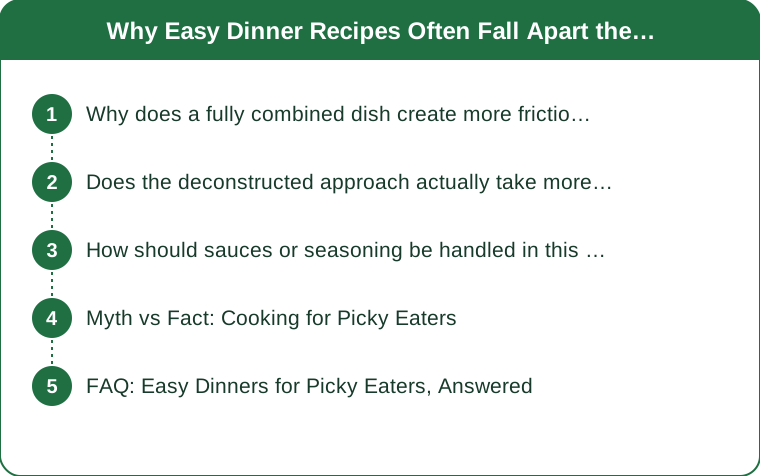
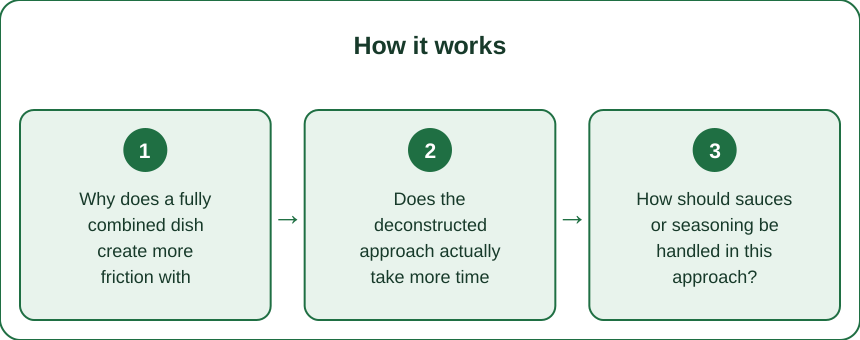
Why does a fully combined dish create more friction with picky eaters than separate components?
A casserole or stir-fry mixes flavors and textures together in a way that’s hard to selectively eat around, so a picky eater often rejects the whole dish even if they’d happily eat some of its individual ingredients on their own, which is the core mismatch between typical easy-dinner recipes and picky eating patterns.
Does the deconstructed approach actually take more time than a combined recipe?
Not meaningfully — most components (a roasted vegetable, a simple protein, rice or pasta) require close to the same prep and cook time whether served combined or separately, so the extra effort is mainly in plating rather than in additional cooking steps.

How should sauces or seasoning be handled in this approach?
Keeping sauce or heavier seasoning separate and added at the table, rather than mixed in during cooking, lets a picky eater control exactly how much flavor intensity they’re comfortable with, which often resolves texture or flavor-based rejection more effectively than trying to guess the right amount during cooking.
Myth vs Fact: Cooking for Picky Eaters
Myth: Accommodating a picky eater always means cooking a completely separate meal. Fact: A deconstructed component-based dinner accommodates picky eating without doubling the cooking workload.
Myth: Picky eating is just about pickiness and doesn’t relate to how food is prepared. Fact: How ingredients are combined and seasoned significantly affects whether a picky eater will try or accept a dish.
FAQ: Easy Dinners for Picky Eaters, Answered
Is it worth introducing new foods within this component-based structure?
Yes, offering one small new item alongside familiar accepted components, without pressure to finish it, is a commonly recommended way to gradually expand accepted foods over time.
Does this approach work for young children as well as adult picky eaters?
Yes, the same component-separation principle applies well across ages, since it’s fundamentally about texture and flavor control rather than age-specific pickiness.
How many components should a typical deconstructed dinner have?
Most work well with three: a protein, a starch, and a vegetable, kept simply prepared so each element stands on its own without needing a specific combination to taste good.
TL;DR:
- Combined dishes are harder for picky eaters to selectively navigate than separate components
- A protein-starch-vegetable component structure takes about the same total time as one combined recipe
- Keeping sauces separate lets a picky eater control flavor intensity themselves
- Introducing one small new item alongside familiar components helps expand accepted foods gradually
Deconstructing an easy dinner into separate components, rather than force-combining everything, solves picky eating friction without meaningfully increasing cooking effort.
Keep Reading
This article is for general informational purposes only and is not medical advice. Always consult a qualified health professional for guidance specific to you.