Why the Dinner You Can Cook Half Asleep Is Worth Designing
Quick Answer: A default dinner is one specific meal you can make without a recipe, without a decision, and without a shopping trip - and it needs to be designed for your worst evening, not your average one. The requirements: under 20 minutes, five ingredients or fewer, all shelf-stable or freezer-stable, one pan, and no chopping that needs attention. Most people’s accidental default fails at least two of these, which is why it stops working exactly when they need it.
It is 7:15pm, you have been awake since six, and the decision about what to eat feels genuinely harder than the cooking would be.

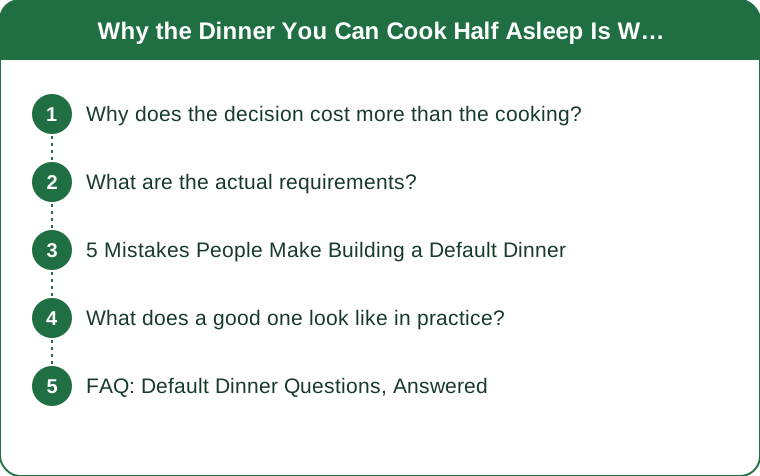
Why does the decision cost more than the cooking?
Because by evening you have spent the resource that decisions run on, and dinner arrives at the exact bottom of that curve.
Decision quality declines through the day. After a day of choices at work and at home, the capacity for another open-ended one is depleted. Dinner is not hard because cooking is hard - it is hard because it is an unbounded question asked at the worst possible hour.
Open-ended questions are the expensive kind. What should we eat has an enormous answer space. What is missing from the default dinner has an answer space of about four items. The second question is trivially easy at 7pm; the first is not.
Scrolling for a recipe makes it worse. Ten minutes of browsing adds dozens of micro-decisions and ends with something requiring an ingredient you do not have. The search itself is a significant part of the fatigue people attribute to cooking.
This is why takeout wins. Takeout is not easier to obtain than a 15-minute pasta. It is easier to decide, because the options are narrow and pre-formatted. A designed default dinner competes on exactly that axis, which is the only axis that matters at that hour.
What are the actual requirements?
Five, and skipping any one is how a default fails on the night it is needed.
1. Under 20 minutes, start to plate. Beyond that, tired-you will reject it in favor of something faster. Twenty minutes is roughly the ceiling for what feels acceptable when depleted.
2. Five ingredients or fewer. Every additional ingredient is another chance one is missing, and one missing ingredient reopens the whole decision.
3. Everything shelf-stable or freezer-stable. This is the requirement people most often break. A default that depends on fresh produce fails on day five of the week, which is precisely when defaults are needed. Frozen vegetables, canned beans and tomatoes, dried pasta, eggs, and frozen protein all qualify.
4. One pan, minimal cleanup. The dishes are part of the cost, and tired-you correctly counts them in advance.
5. No attention-dependent steps. Nothing that burns in 30 seconds, nothing requiring precise timing, nothing needing careful knife work. It has to survive being cooked badly, because on the nights it matters it will be.
A useful sixth, optional: it should be something you like at about a 7 out of 10, not a 10. A meal you love gets saved for occasions. A meal you reliably enjoy gets made on a Tuesday.

5 Mistakes People Make Building a Default Dinner
Mistake 1: Choosing something impressive. The default is infrastructure, not a showcase. If you would be pleased to serve it to guests, it is probably too complicated to be the thing you make when you are exhausted.
Mistake 2: Building it around fresh ingredients. Fresh food runs out mid-week and spoils. The default has to work from a pantry that has not been shopped in nine days, or it is not a default.
Mistake 3: Having three of them. Three defaults means a choice, and a choice is the thing you are trying to eliminate. One default, plus one variation of it, is the correct number.
Mistake 4: Not stocking for it deliberately. A default only works if the components are always present, which means adding them to every shopping trip whether or not you used them. Treat them as permanent stock, like dish soap - checked and replaced automatically rather than decided on.
Mistake 5: Judging it by how it tastes on a good day. Cook it on a good evening and it will seem underwhelming compared to what you could make. Its value only appears on the bad evening, when the alternative was delivery or cereal. Judge it against that, not against your best cooking.
What does a good one look like in practice?
Several shapes work. The point is picking one and stocking it, not finding the objectively best one.
The pantry pasta. Dried pasta, canned tomatoes or a jar of sauce, a can of white beans or a frozen protein, frozen spinach, and something salty - anchovies, olives, or parmesan. Fifteen minutes, one pot plus a colander, and every element keeps indefinitely.
The egg dinner. Eggs, frozen vegetables, a tortilla or bread, and cheese. Eggs are the most forgiving default protein available - fast, cheap, endlessly variable, and they store for weeks.
The rice bowl. Microwave rice pouch, canned or frozen protein, frozen vegetables, and a sauce you always keep. Under ten minutes, one pan, and it accepts nearly any substitution without failing.
The soup upgrade. A canned or carton soup base, plus a can of beans, plus frozen greens, plus something crunchy on top. The base does the work; the additions turn it into a meal.
The variation rule: whichever you choose, define one deliberate variation - a different sauce, a different protein - so the same components deliver two meals. That single variation is what prevents the boredom that otherwise kills a default within a month.
Then write it on the inside of a cupboard door. Not a recipe, just the five items. Tired-you should not have to remember what the default is.
FAQ: Default Dinner Questions, Answered
Will I get sick of eating it?
You would if you ate it daily, and that is not the use case. A default typically gets made once or twice a week - on the bad evenings. At that frequency, with one variation, it stays fine for a long time.
What if I cook for a family with different preferences?
Choose a default with a deconstructed serving format - rice bowls, tacos, or pasta with the sauce added at the plate. Components everyone assembles themselves solve the preference problem without multiplying the cooking.
Is it worse nutritionally than cooking properly?
It should not be, and if it is, redesign it. A default built on beans, frozen vegetables, eggs, and whole grains is nutritionally solid. Frozen vegetables are nutritionally comparable to fresh and often better than fresh produce that has sat in a fridge for a week.
How do I stop the ingredients from getting used for other meals?
Buy doubles of the default components and keep them physically separate - a labeled shelf or a specific bin. If the emergency pasta gets eaten on a normal Tuesday, the default is unavailable on the night that counts.
This is general information, not medical advice.
TL;DR:
- The exhausting part of dinner is the open-ended decision, not the cooking - which is why takeout wins on ease of choosing, not ease of getting.
- A real default needs five things: under 20 minutes, five ingredients, shelf or freezer stable, one pan, no attention-dependent steps.
- Have exactly one default plus one variation. Three defaults reintroduces the choice you were eliminating.
- Stock the components permanently and keep them separate, so they are there on the night that actually needs them.
Designing one takes about ten minutes on a calm Sunday and pays back for years. The reason so few people have a good one is that they build it while feeling capable, for a version of themselves who is also feeling capable - and that person was never the one who needed it.
Keep Reading
This article is for general informational purposes only and is not medical advice. Always consult a qualified health professional for guidance specific to you.