Why the Same Easy Dinner Recipe Tastes Different Every Time You Make It
Quick Answer: Most night-to-night variation in a familiar recipe comes from ingredient-level differences (produce ripeness, spice freshness, salt brand) and small timing or heat differences, not from actually following the recipe wrong — home cooking has far more uncontrolled variables than a printed recipe accounts for.
It’s easy to blame inconsistency on cooking skill, but most of the variation between two “identical” attempts at the same easy dinner recipe comes from sources that have nothing to do with technique.

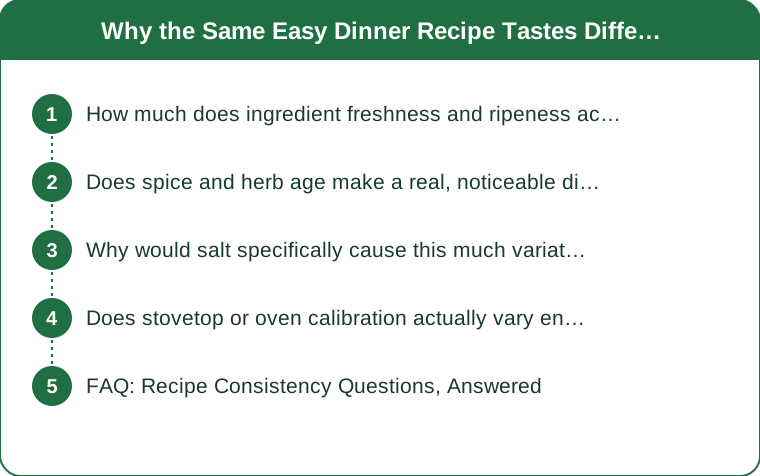
How much does ingredient freshness and ripeness actually explain this?
A significant amount — produce like tomatoes, onions, and garlic vary meaningfully in water content, sweetness, and pungency depending on ripeness and how recently harvested, and a recipe written around “one onion” doesn’t account for the real difference between a very fresh, sharp onion and an older, milder one — this alone can noticeably shift a dish’s balance without any change in technique.
Does spice and herb age make a real, noticeable difference?
Dried spices lose potency measurably over time (many lose significant aromatic strength within 6-12 months of opening), so the “same” teaspoon of cumin from a jar that’s been open eight months delivers meaningfully less flavor impact than the same measurement from a fresher jar — this is one of the most common, least-suspected sources of recipe inconsistency.

Why would salt specifically cause this much variation between attempts?
Different salt types (table salt, kosher salt, sea salt) vary significantly in crystal size and therefore actual sodium delivered per teaspoon — a teaspoon of fine table salt delivers meaningfully more sodium than a teaspoon of coarse kosher salt, so switching brands or types mid-recipe-repertoire (a very common, often unnoticed habit) shifts seasoning balance without changing the measured amount at all.
Does stovetop or oven calibration actually vary enough between attempts to matter?
Yes, more than most people expect — home stovetop “medium heat” varies significantly between burners and appliances, and ovens frequently run 15-25 degrees off their set temperature without recalibration; cooking the same recipe on a different burner or in a different oven than usual introduces a real, measurable timing and doneness variable independent of the recipe or technique.
FAQ: Recipe Consistency Questions, Answered
Is there a way to reduce this variation for a dinner I make often?
Tasting and adjusting seasoning at the end (rather than trusting the exact measurement every time) compensates for most ingredient-level variation, and is a more reliable habit than assuming a fixed measurement always produces a fixed result.
Does using a kitchen scale instead of measuring cups actually reduce this inconsistency?
For baking specifically, yes, meaningfully — weight measurement removes a real source of variation that volume measurement introduces; for savory cooking with produce-based ingredients, a scale helps less since the ingredient’s internal variation (ripeness, water content) matters more than measurement precision.
Should I be concerned if a dinner recipe tastes noticeably different every single time despite consistent ingredients?
Some variation is completely normal and expected; if the difference is dramatic and consistent measurement, fresh ingredients, and calibrated equipment don’t narrow it, revisiting the recipe’s actual technique steps (not just ingredient list) is worth doing.
TL;DR:
- Produce ripeness and freshness shift a dish’s flavor balance more than most people expect
- Spice potency fades measurably over months, changing flavor with the exact same measurement
- Salt type changes actual sodium delivered per teaspoon, independent of technique
- Stovetop and oven calibration differences add a real, uncontrolled timing variable
The recipe probably isn’t the inconsistent part — the ingredients and equipment around it are.
Keep Reading
This article is for general informational purposes only and is not medical advice. Always consult a qualified health professional for guidance specific to you.