Why Do the Same Easy Dinner Recipes Eventually Stop Feeling Easy?
Quick Answer: The recipe didn’t get harder — decision fatigue and repetition fatigue made the same steps feel heavier over time, even though the actual cooking time and effort stayed identical. It’s a psychological shift, not a practical one.
You picked “easy” dinners specifically so cooking wouldn’t be a daily decision, and for a while that worked — so why does the exact same 20-minute stir-fry now feel like more effort than it used to?

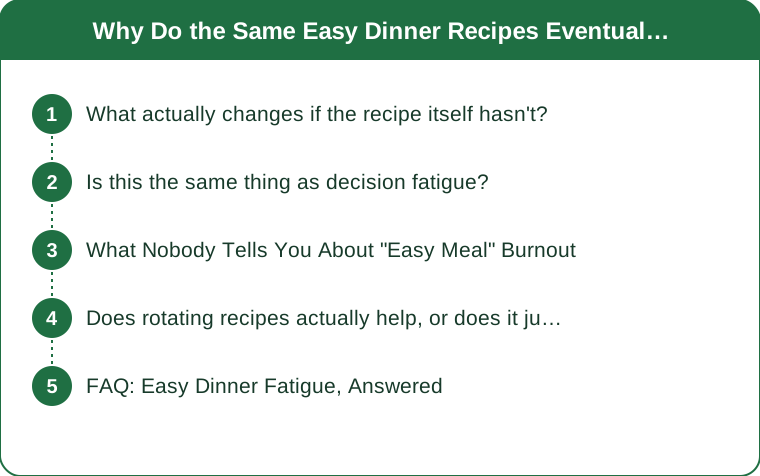
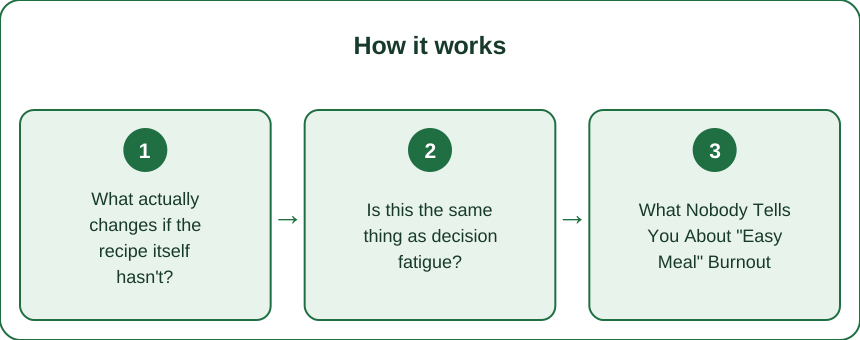
What actually changes if the recipe itself hasn’t?
Novelty wears off, and with it goes some of the small dopamine hit that made cooking feel engaging rather than routine. This isn’t unique to cooking — any repeated task loses some perceived ease over time purely from familiarity, independent of whether the task objectively got harder.
Is this the same thing as decision fatigue?
Related but distinct. Decision fatigue is about the mental cost of choosing what to make; this is more about the diminishing reward of making something you’ve made many times before. Even with zero decision involved (say, a fixed weekly rotation), the repetition itself can make a task feel more effortful the hundredth time than the tenth.

What Nobody Tells You About “Easy Meal” Burnout
Recipe burnout often gets misread as “I need more complicated recipes” or “I’m bad at meal planning,” when the actual fix is usually much smaller: swapping just one or two ingredients or spices in an otherwise identical recipe restores enough novelty to reset the fatigue, without adding any real time or difficulty.
Does rotating recipes actually help, or does it just delay the same problem?
It helps meaningfully if the rotation is wide enough (6-8 distinct meals) that you’re not repeating any single one more than once a week or so — the fatigue is tied to frequency of repetition, not the total number of times you’ve ever made something. A rotation of only 2-3 meals repeated constantly will burn out just as fast as a single go-to recipe.
FAQ: Easy Dinner Fatigue, Answered
Does adding complexity actually fix the fatigue, or just add more effort?
Usually just adds effort without fixing the core issue — small variation (a new spice, a different vegetable) resets novelty more efficiently than adding steps or cook time.
How often should a dinner rotation actually change?
Refreshing 1-2 recipes in your rotation every few weeks, rather than overhauling the whole rotation at once, keeps novelty without requiring constant new recipe research.
Is meal fatigue a sign I should try meal delivery or takeout more often?
It can be a reasonable occasional reset, but it doesn’t address the underlying repetition fatigue long-term — small recipe variation tends to be a more sustainable fix.
TL;DR:
- The recipe didn’t get harder — repetition fatigue makes familiar tasks feel heavier over time
- This is distinct from decision fatigue, which is about choosing rather than doing
- Small ingredient or spice swaps reset novelty more efficiently than adding complexity
- A rotation of 6-8 meals prevents the fatigue that a 2-3 meal rotation eventually hits
The fix for easy-dinner burnout is usually smaller than it feels — a small swap, not a bigger recipe.
Keep Reading
This article is for general informational purposes only and is not medical advice. Always consult a qualified health professional for guidance specific to you.